Central Asia at Venice: Kazakhstan, Kyrgyzstan and Uzbekistan at the Biennale 2026
Updated: May 30
By Saadat S.
May 17, 2026

There is a particular kind of cultural confidence that cannot be manufactured. It does not arrive through institutional backing or carefully managed visibility strategies. It arrives the way it has always arrived — through the work itself. This is what Kazakhstan, Kyrgyzstan, and Uzbekistan brought to the 61st Venice Biennale. And it is, without question, one of the most important stories of the season.
The conversation around Central Asia in the international art world has too often been framed as one of discovery. As though the region and its artists have been waiting, patiently, to be found. What this year's Biennale makes unmistakably clear is that the waiting, if there ever was any, is over. Kazakhstan: The Architecture of Silence

Smail Bayaliyev, Steppe Architectonics, Kazakhstan Pavilion, Venice Biennale 2026. Towering, ancient, unmovable — the steppe rises in the middle of Venice. Photograph: Keshav Anand / Luca Girardini. Courtesy A&A Worldwide.
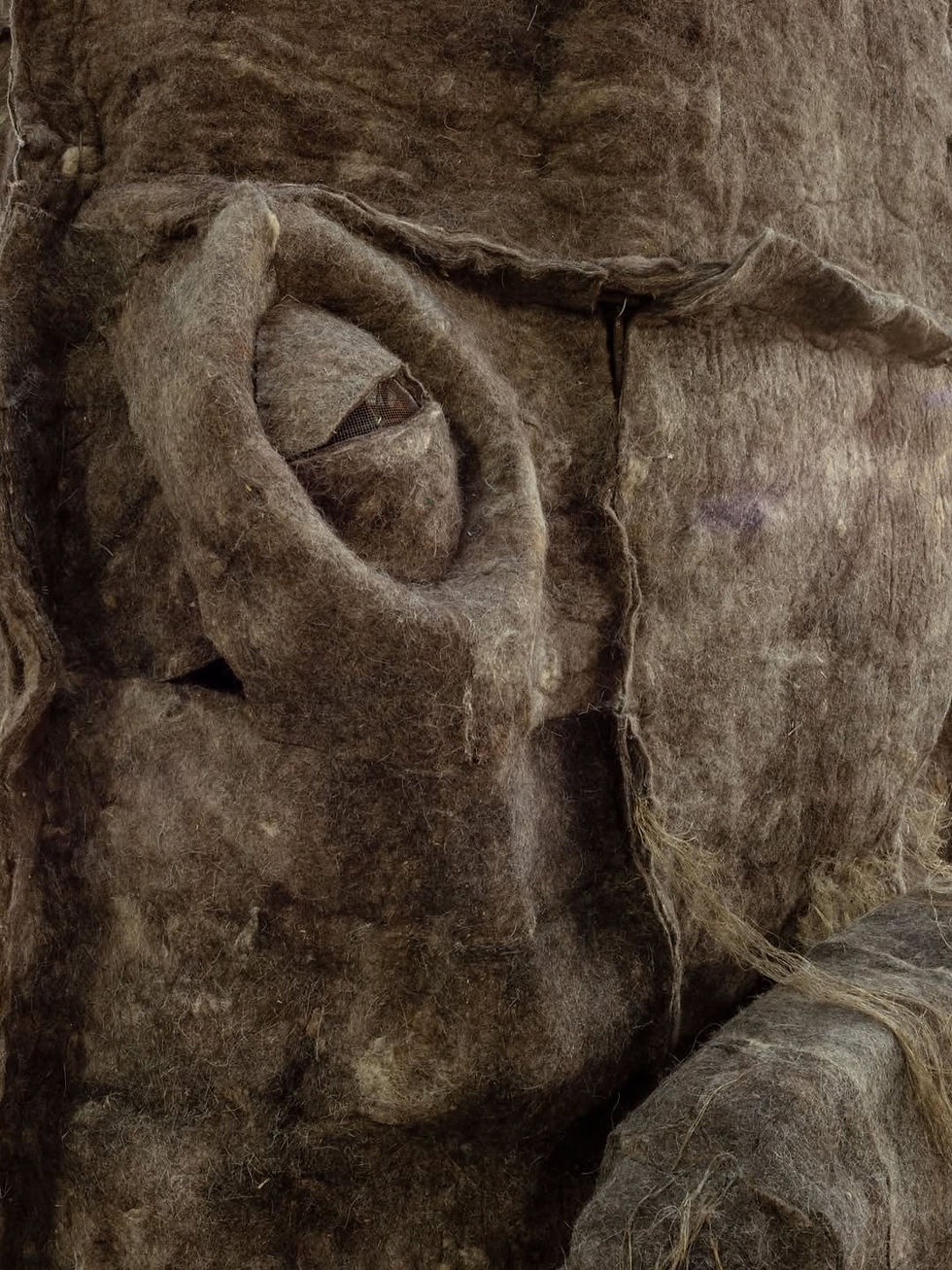
To enter Qoñyr: The Archive of Silence is to be asked, immediately, to become a different kind of viewer. Before the doors of the Museo Storico Navale, the sound installation Dübir folds the rhythm of horse hooves and the low frequencies of the Kazakh steppe into the ambient texture of Venice — and something fundamental shifts. You are no longer in the mode of consumption that a Biennale can so easily encourage. You are listening.
This is precisely the intention of curator Syrlybek Bekbota, whose concept was selected through the first open competitive call in Central Asian pavilion history — itself a structural statement as significant as anything on the walls. Qoñyr is a Kazakh word of unusual density: it carries within it a brown hue, a nostalgic sonic register, the scent of earth, and a silence that is not absence but accumulation. Across six interconnected rooms and nine artists, the exhibition moves through the full register of that accumulation. Worn Soviet arrest warrants connected by red thread. A reconstructed domestic interior from the late Soviet period, rendered with the precision of someone who understands that the ordinary is where history lives. A three-channel video that marries LIDAR scanning technology with the voices of villagers who have lived beside an ancient cave for generations, binding the most contemporary imaging tools to the oldest forms of human testimony.
The result is an exhibition of rare and considered restraint — one that understands, deeply, that silence can be the loudest argument a culture makes.
Uzbekistan: What the Water Remembers

Before the 1960s, the Aral Sea was one of the great inland bodies of water on earth, stretching across nearly 70,000 square kilometres and sustaining entire communities along its shores. Soviet agricultural policy — specifically, the diversion of its source rivers to irrigate vast cotton plantations across the Uzbek steppe — reduced it, over the course of five decades, to largely desert. In the ghost port of Moynaq, rusting fishing trawlers sit in open sand, monuments to a catastrophe so slow and so vast that the world has struggled to fully hold it.
Uzbekistan's pavilion, The Aural Sea, holds it — and does so with a sophistication that refuses every available shortcut. Curated collectively by five young international curators from the inaugural cohort of the Bukhara Biennial Curatorial School, the exhibition turns not to documentation but to myth, understanding that certain forms of loss can only be processed through the imagination. The influence of Karakalpak author Allayar Darmenov — who chose fabulation over chronicle as his mode of engaging with the Aral crisis — runs through every room. Zi Kakhramonova's crystallised salt labyrinth, embedded with the creatures of a vanished sea. Zulfiya Spowart's installation of wood carvings and textile sculptures centred on the beshik cradle, drawing on local myths of motherhood and continuity. A.A.Murakami's large-scale textiles derived from the algorithmic shell patterns of species that no longer exist in waters that no longer exist. Each work proposes a different form of attention — and together they articulate a position that feels genuinely necessary: that imagination is not an evasion of ecological reality but one of its most powerful instruments.
An old Uzbek saying moves quietly through the pavilion: tell your dreams to the water. It implies a reciprocity — that nature does not merely receive, but responds. In a cultural moment saturated with images of crisis and short on frameworks for processing them, The Aural Sea offers something rarer. A way of listening that opens rather than closes.
Kyrgyzstan: The Weight of the Gift

Belek means gift in Kyrgyz — and the word carries a double meaning that Alexey Morosov builds his entire pavilion around. Water as a primordial offering from nature. And the intangible inheritance of a nomadic civilisation — its traditions, its memory, its shared practices — as a gift passed between generations. Both readings coexist inside the former 14th-century church of Santa Caterina in Venice's Cannaregio district, where Morosov's immersive installation occupies 600 square metres of historic space, its architecture absorbed into the work itself.
At the centre is a monumental video fresco — glaciers and rivers dissolving into the Brutalist forms of Soviet-era hydro-engineering infrastructure that irrevocably reshaped Kyrgyzstan's terrain in the latter half of the twentieth century. Around it, sculpture, painting, and sound layer into a single, immersive experience that moves between anthropology, philosophy, and contemporary art without fully belonging to any one of them. Morosov has described the project as a meditation with the tones of something almost noir — sober, searching, unresolved in the way that honest questions always are.

Threading through everything is Kok-Börü, the ancient equestrian game played on horseback with an ulak — a goat carcass — as its object. Morosov treats it not as ethnographic colour but as living cultural energy: evidence of a collective spirit that has survived every geopolitical rupture visited upon the region. "BELEK is not a return to the past," the artist has said, "but a movement through it. This experience does not belong to memory; it operates as an inner geometry." Inner geometry. It is a phrase that articulates, with precision, exactly what distinguishes work that is truly rooted from work that merely references its origins.
The Arrival
Three pavilions. Three distinct curatorial languages. Three nations that have never needed the art world's permission to know who they are. What Venice 2026 offers is simply the occasion — and the audience — to make that knowledge visible on a global stage.
The infrastructure behind this moment is real and worth noting. Kazakhstan's open call process set a new institutional precedent for the region. Uzbekistan's pavilion arrives alongside the inauguration of the Centre for Contemporary Arts Tashkent, the country's first permanent contemporary art institution. Kyrgyzstan is building a Biennale presence of increasing seriousness and ambition. These are not accidents. They are the results of sustained cultural investment, and they are beginning to produce results that the rest of the art world will spend the next several years absorbing.
Central Asia has not emerged. It has always been here. Venice, at last, is listening.

